


Knotless Netting for Construction: Safety, Compliance and Long-Term Performance
Working at height remains one of the highest-risk activities across the construction sector. Choosing reliable containment and fall arrest systems directly shapes site compliance, worker protection and operational efficiency. Knotless netting has become a preferred solution for modern construction sites, thanks to its uniform strength, stable mesh geometry and predictable impact performance compared with traditional knotted alternatives.
What Makes Construction-Grade Knotless Netting Different
Knotless netting, typically produced by Raschel warp-knitting or twisted-braid construction, locks filaments together at each node without a discrete knot. The result is a continuous load path along the mesh bars, with lower stress concentration and better preservation of the yarn's inherent tensile strength. Most certified versions are produced from UV-stabilised high-tenacity polyester or HDPE, engineered for permanent outdoor exposure on scaffolding, floor openings, roof edges and catch fan assemblies.
In knotted netting, knots create concentrated stress points. Synthetic twine can lose 30–60% of its rated tenacity at knot locations, and knots will permanently tighten after an impact, reducing the net’s ability to absorb energy in subsequent falls. Knotless design eliminates this weakness: tensile force spreads evenly across the whole panel, and the mesh retains its original shape and absorption capacity after a single impact event. WorkSafe guidance explicitly recommends knotless square-mesh netting for System S fall arrest applications for this reason.
Core Construction Applications of Knotless Netting
The largest construction application is fall arrest and guardrail netting.
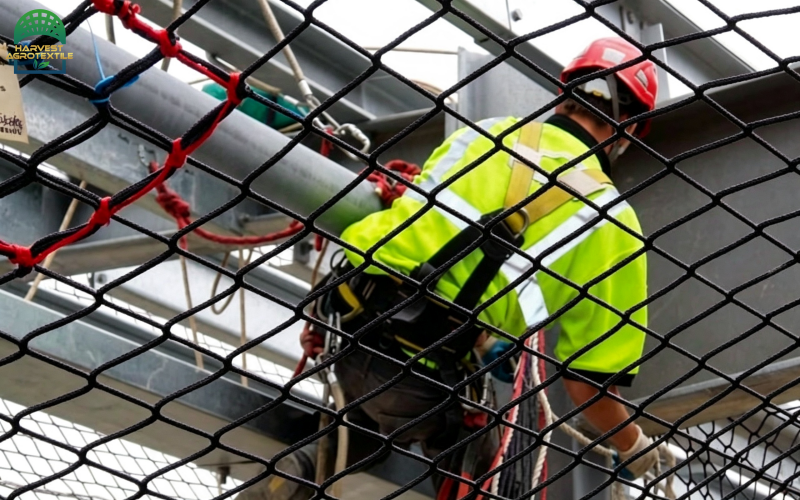
Installed horizontally beneath elevated work areas, knotless fall arrest nets catch workers in the event of a fall and dissipate impact energy gently. These nets follow recognised European safety standards for construction fall protection and are widely selected by site safety teams for reliable height safety.
The smooth, knot-free structure helps spread impact force evenly across the whole panel. Unlike knotted alternatives, there are no concentrated stress points that can weaken the net when loaded. Proper installation leaves enough clearance space underneath the net, so the falling person will not hit the ground or lower structures when the net stretches under impact.
2. Scaffold debris containment netting
Vertical knotless panels line scaffolding perimeters to contain bricks, fixings, tools and construction waste. The smooth, knot-free surface minimises snags on scaffolding tubes, clamps and moving equipment, reducing accidental tearing during daily site activity. UV stabilisation prevents rapid degradation under continuous sunlight, extending service life through multi-phase building cycles.
3. Engineered enclosures for use in sensitive environments or high-wind areas
In the Skyline Queenstown project in New Zealand, a custom net shelf was installed at a viewing platform to prevent mobile phones and loose objects from falling into an alpine environment. The specification called for high-tenacity polypropylene knotless netting, selected for strength, durability, and minimal visual impact, with physical drop testing used to fine-tune impact absorption and rebound control. This illustrates a broader trend: knotless netting is being chosen not only where the load case is severe, but where the net must perform discreetly and predictably over a long service life.
For construction businesses balancing site safety, regulatory compliance and practical site usability, knotless netting delivers measurable advantages over older knotted netting systems. Its predictable energy absorption, stable mesh and low-snag surface make it suitable for both permanent scaffolding enclosures and temporary fall arrest zones on high-rise, commercial and residential projects.
If you are sourcing certified netting for your next build, review our [knotless safety net ] to match mesh size, energy class and edge reinforcement to your site’s working-at-height requirements.